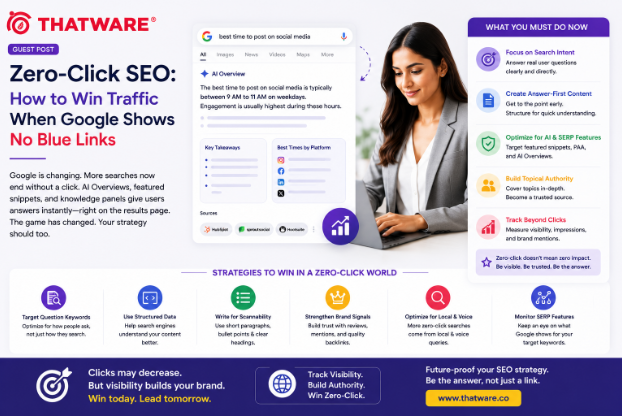
Pull up your phone. Search for something — the capital of a country, a recipe conversion, the definition of a word. Odds are you got your answer without clicking a single link. Google told you. Right there, at the top. No blue links required.
That’s zero-click search. And it’s not a bug or an experiment anymore. It’s the default experience for a growing percentage of queries. Studies have consistently shown that a substantial portion of Google searches end without a single click to any website. And with AI Overviews expanding across more and more query types, that number is only heading one direction.
So if you’re an SEO professional or a business owner watching your organic traffic flatten despite solid rankings — this is a big part of why. And figuring out how to win in this environment is one of the defining challenges of search marketing right now.
What’s Actually Happening
Zero-click isn’t new, exactly. Featured snippets, knowledge panels, and local packs have been eating into click-through rates for years. But the scale has changed dramatically. AI Overviews synthesize multi-step answers that used to require a visit to multiple pages. Conversational AI tools answer follow-up questions without the user ever leaving the chat interface.
For purely informational queries — “how does X work,” “what is Y,” “difference between A and B” — the traffic opportunity has shrunk significantly. Google is becoming more of an answer engine and less of a directory. That transition is mostly complete for simple queries and accelerating for complex ones.
The question isn’t whether this is happening. It’s what you do about it.
The Shift in Strategy
Here’s the reframe that actually helps: stop thinking about zero-click as lost traffic and start thinking about it as a different kind of visibility opportunity.
When your content gets pulled into a featured snippet or an AI Overview, your brand name appears. Your domain appears. For users who are just beginning their research, that exposure creates familiarity. Some of them will click through eventually, even if not immediately. Some will search for your brand directly next time. Some will remember the name when they’re ready to buy.
This is a top-of-funnel value that doesn’t show up cleanly in your click analytics — but it’s real.
Zero-click SEO optimization services are specifically designed around this reality: optimizing not just for traffic, but for brand visibility in the new SERP landscape. That means structuring content to win featured snippets deliberately, optimizing for knowledge panel inclusion, and building the kind of brand signals that make your name appear credible when Google synthesizes an answer.
What Actually Works
Featured snippet optimization is still very much alive. Structuring content with clear question-and-answer formats, concise definitions followed by expanded explanations, and clean list or table formats gives you a real shot at zero-click real estate. The brand whose content gets pulled into the snippet still wins something — even if the user doesn’t click.
Entity building matters enormously. When Google’s systems understand clearly who you are, what you do, and what you’re authoritative about, your brand is more likely to appear in knowledge panels and AI-generated summaries. Structured data, consistent NAP information, Wikipedia presence, Google Business Profile optimization — all of this feeds into entity clarity.
Targeting non-zero-click query types deliberately is also a smart strategy. Transactional queries (“buy X,” “X near me,” “X pricing”) still drive clicks, because Google can’t complete a purchase on your behalf. Complex research queries with genuine nuance still drive clicks, because a two-sentence AI answer doesn’t fully satisfy them. Bottom-of-funnel content — comparisons, case studies, specific product pages — still captures traffic from users who are close to a decision.
The goal is to build a content portfolio that spans both: content optimized for visibility in zero-click environments (building brand familiarity and authority) and content optimized for click capture in query types where people still need to go somewhere.
Partnering with a future-proof SEO agency that understands this dual strategy — rather than one still optimizing purely for ranking — is increasingly the difference between a traffic strategy that works in 2026 and one that’s chasing a reality that no longer quite exists.
The Broader Point
Zero-click search is a symptom of a deeper change: Google is becoming better at satisfying users without making them leave. That’s good for users. It’s a challenge for publishers. But it’s not a death sentence.
The brands that adapt — that understand visibility now means more than just ranking, that content strategy means thinking about AI synthesis and not just keyword placement — will build a durable digital presence that survives the next round of changes too. Whatever those turn out to be.